University of Essex: XR Integration in Higher Education
Advancing Immersive Learning at Scale
Company
University of Essex - School of Computer Science
Location
Colchester, UK
Duration
2019 - Present
Role
Associate Professor & Research Lead
Overview
Led research initiatives integrating immersive technologies into higher education curriculum, securing £250K Innovate UK funding and £5M EU Horizon funding for collaborative research projects.
Challenge
Universities faced pressure to modernize curricula and improve student engagement. Immersive technologies showed promise but lacked proven pedagogical frameworks. Faculty needed evidence-based guidance on implementation and student outcomes.
Solution
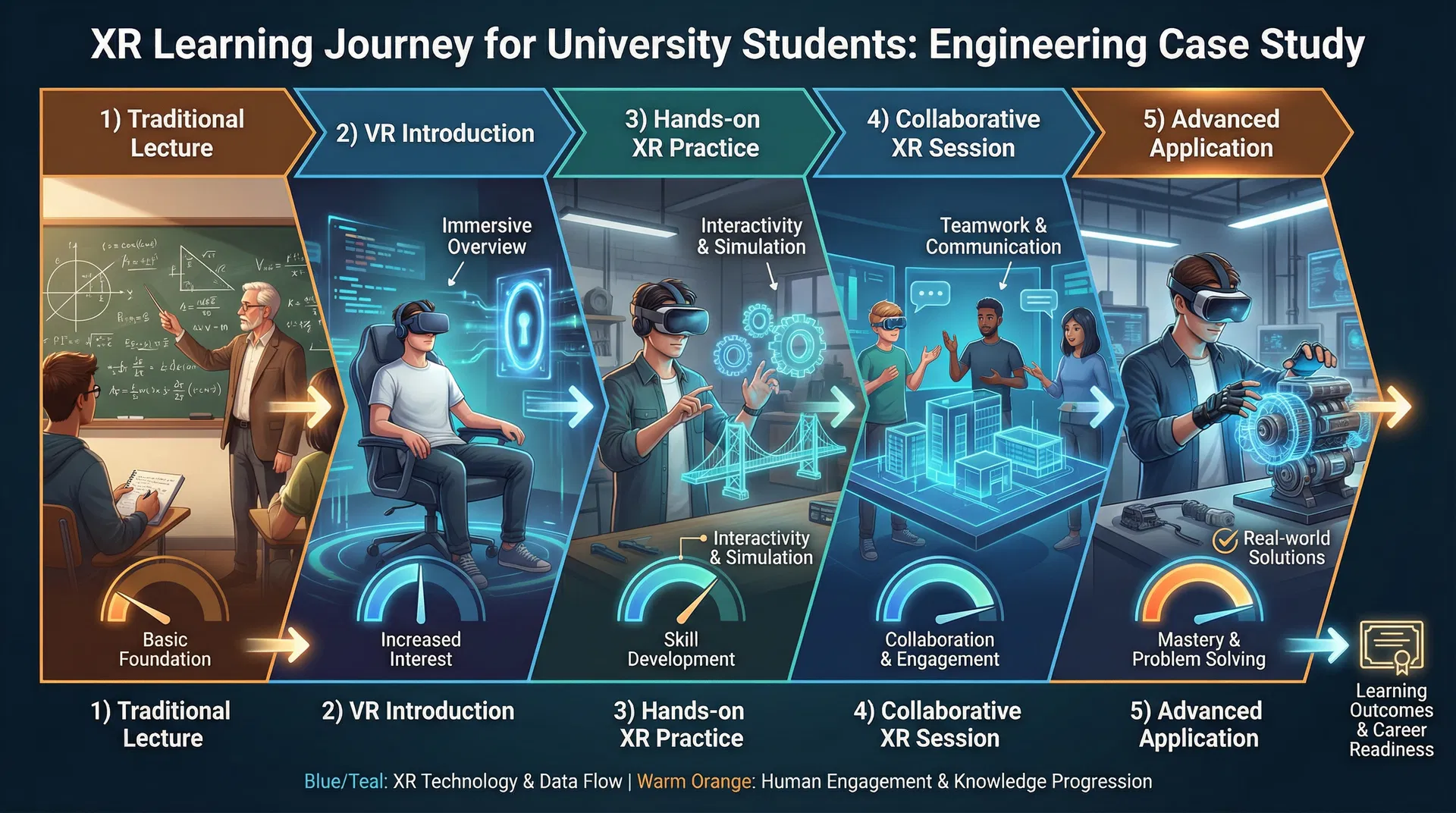
Developed comprehensive XR curriculum integration framework including pedagogical guidelines, accessibility standards, and faculty training programs. Created immersive learning modules for multiple disciplines (engineering, medicine, design).
Research Phase
Longitudinal Learning Study
Duration: 2 years | Participants: 200
Research Methods
Key Findings
Knowledge Retention
Students using VR-based learning showed 35% improvement in knowledge retention compared to traditional lectures
Impact: Validated immersive learning effectiveness for STEM subjects
Engagement Metrics
Hands-on immersive experiences increased engagement by 45% compared to traditional lectures
Impact: Demonstrated measurable impact on student motivation and participation
Accessibility Requirements
Accessibility features were critical for inclusive learning environments
Impact: Made accessibility a core requirement in all XR learning modules
Faculty Adoption Barriers
Faculty training and support were key adoption barriers
Impact: Developed comprehensive faculty training program and ongoing support
User Personas
Understanding the diverse needs and motivations of key user segments
Dr. James Mitchell
Engineering Professor
University of Essex
BACKGROUND
25 years teaching mechanical engineering, traditional lecture-based approach
GOALS
- •Improve student understanding of complex concepts
- •Reduce time spent on repetitive explanations
- •Stay relevant with modern teaching methods
PAIN POINTS
- •Steep learning curve for new technology
- •Limited time for training and experimentation
- •Concerns about technology reliability in classroom
"I want to use technology that actually helps students learn, not just for the sake of innovation"
Aisha Patel
Student - Engineering
University of Essex
BACKGROUND
Second-year student, visual learner, interested in practical applications
GOALS
- •Understand complex engineering concepts
- •Apply knowledge to real-world problems
- •Prepare for industry career
PAIN POINTS
- •Difficulty visualizing abstract concepts in lectures
- •Limited hands-on experience with equipment
- •Passive learning in large lecture halls
"When I can see and interact with the concepts, everything makes sense"
Prof. Rachel Adams
Department Head
University of Essex
BACKGROUND
15 years in academic leadership, focused on research excellence and student outcomes
GOALS
- •Attract top students and faculty
- •Secure research funding
- •Establish university as innovation leader
PAIN POINTS
- •Competing for limited research funding
- •Pressure to demonstrate research impact
- •Faculty resistance to change
"We need to demonstrate that our research translates to real educational impact"
Implementation Approach
Research & Framework Development
6 months
- Literature review and best practices analysis
- Pedagogical framework design
- Accessibility standards development
- Technology evaluation and selection
Pilot Program & Faculty Training
6 months
- Faculty recruitment and training
- Pilot course development (3 disciplines)
- Student cohort recruitment
- Baseline learning metrics collection
Evaluation & Scaling
12 months
- Longitudinal learning outcome tracking
- Student and faculty feedback collection
- Module refinement based on findings
- Expansion to additional departments
Outcomes & Results
Successfully demonstrated measurable learning outcomes with immersive technologies, attracting significant research funding and establishing the university as a leader in XR education research.
£250K
Innovate UK Funding
For pedagogical research
£5M
EU Horizon Funding
For collaborative research network
500+
Students Impacted
Across multiple disciplines
+35%
Learning Improvement
Knowledge retention vs traditional
87%
Faculty Adoption
Of trained faculty using XR in courses
Research Visualizations

Key Learnings
Evidence-Based Innovation
Key Insight
Rigorous research methodology is essential for validating emerging technology benefits. Quantifiable learning outcomes convince stakeholders and secure funding.
Accessibility First
Key Insight
Accessibility and inclusive design are non-negotiable for educational technology. They improve experience for all users, not just those with disabilities.
Stakeholder Engagement Critical
Key Insight
Faculty, student, and administrator engagement is critical for adoption. Early involvement in design and continuous feedback loops ensure success.